The short answer
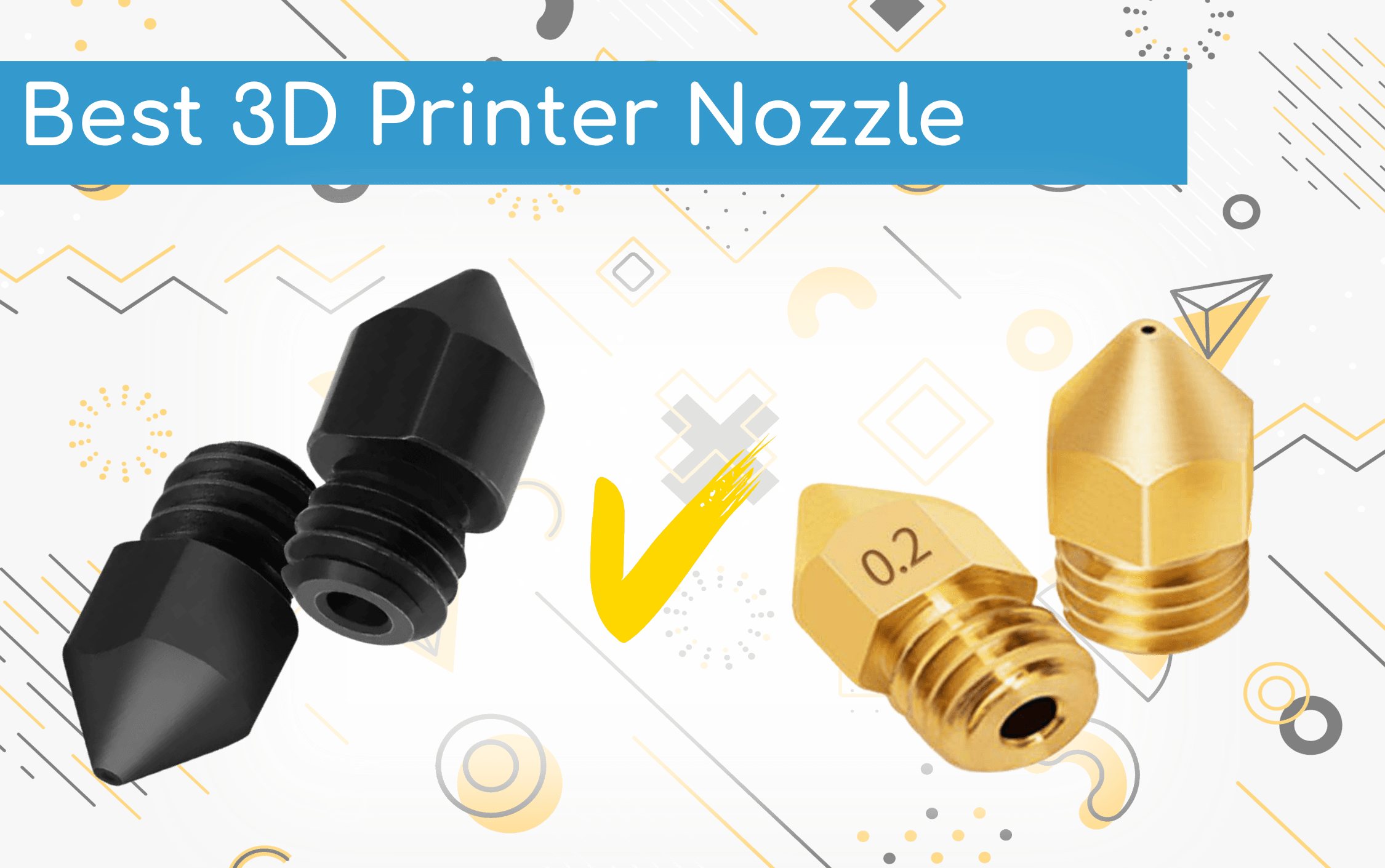
Use a brass nozzle for everyday PLA, PETG, ABS and other non-abrasive filament. Brass heats quickly, holds temperature well and is inexpensive to replace. Use a hardened-steel nozzle when a filament contains carbon fibre, glass fibre, metal, wood, glow pigment or another abrasive additive.
Nozzle choice at a glance
- Everyday filament
- Brass
- Best heat transfer and value
- Abrasive filament
- Hardened steel
- Resists bore wear
- Common starting size
- 0.4 mm
- Balanced detail and print time
- Filled-filament size
- 0.6 mm or larger
- Reduces clogging risk
Brass nozzles for everyday printing
Brass is the standard nozzle material on most hobby FDM printers because it transfers heat efficiently. That helps the melt zone recover quickly when speed or flow changes, making temperature tuning forgiving for common filament.
Its weakness is wear. Abrasive particles gradually enlarge and distort the bore, which changes line width and extrusion consistency. A worn 0.4 mm nozzle may still extrude, but it no longer behaves like a calibrated 0.4 mm nozzle.
Brass works well with
- PLA and PLA+
- PETG
- ABS and ASA
- TPU and other non-filled flexible filament
- Non-filled nylon
Hardened steel for abrasive filament
Hardened steel gives up some thermal conductivity in exchange for much better wear resistance. It is the practical choice for carbon-fibre, glass-fibre, metal-filled, wood-filled and glow-in-the-dark filament.
After changing from brass, begin with the filament maker’s profile and tune from there. Some printers need a slightly higher nozzle temperature or slower maximum volumetric flow because steel transfers heat less efficiently.
Filament compatibility
| Platform or version | Status | Notes |
|---|---|---|
| PLA, PETG, ABS, ASA and TPU | Supported | A brass nozzle is normally the simplest choice. |
| Carbon- or glass-fibre composites | Check notes | Use hardened steel or another abrasion-resistant nozzle. |
| Metal-, wood- or glow-filled filament | Check notes | Use an abrasion-resistant nozzle; 0.6 mm or larger often reduces clogging. |
| Food-contact parts | Check notes | Nozzle material alone does not make a printed part food-safe. |
Choosing a nozzle diameter
Diameter changes both feature size and flow. A smaller nozzle can resolve finer details but prints more slowly and clogs more easily. A larger nozzle lays down wider lines, shortens print time and is often friendlier to filled filament.
| Nozzle diameter | Good starting use | Main trade-off |
|---|---|---|
| 0.2–0.3 mm | Miniatures, small text and fine surface detail | Long print times and higher clog risk |
| 0.4 mm | General-purpose printing | Balanced rather than specialised |
| 0.6–0.8 mm | Functional parts, larger models and filled filament | Less fine detail |
| 1.0 mm | Very large, fast or high-flow parts | Visible layer lines and limited small features |
A practical starter set
For a first set of spares, keep a 0.4 mm brass nozzle for normal work, a 0.6 mm brass nozzle for faster functional prints and a hardened-steel nozzle sized for the abrasive filament you actually use. Re-run first-layer, flow and temperature checks whenever the installed nozzle changes.